Why setting an instantaneous gas detector alarm at the TWA can cause problems
9 Nov 2026 | Aleks Todorovic
From 1 December 2026, the Australian 8-hour workplace exposure limit (TWA) for carbon monoxide (CO) drops from 30 ppm to 20 ppm. When reviewing portable gas detector settings, it may seem logical to set the first instantaneous alarm, A1, at 20 ppm as well. [1]
Workplace exposure limits identify the substance or hazard being assessed and the period over which exposure is averaged. The time-weighted average (TWA) relates to an 8-hour working day, while the short-term exposure limit (STEL) relates to a 15-minute average. These averaged values were developed to assess exposure over a specific period of time. Applying either value directly as an instantaneous alarm requires a separate justification based on the hazard and the intended response. [1, 2]
Safe Work Australia’s technical guide describes the development of real-time monitoring from primarily static or area instruments used to evaluate workplace controls to personal monitors that help identify when exposures occur and how they relate to tasks. These instruments provide immediate warnings and can collect data for exposure assessment. A single momentary reading, however, cannot establish whether an averaged exposure limit has been exceeded. [2]
Instantaneous alarm setpoints therefore need a documented operational purpose, informed by toxicology, exposure variability, measurement capability and the action required. Entering an averaged exposure limit as an instantaneous alarm threshold without considering those factors can lead to repeated alarms, leaving workers unsure what action to take when the alarm sounds.
Start with the decision the worker needs to make, then select the alarm function and setpoint that support it.
Two functions that support different decisions
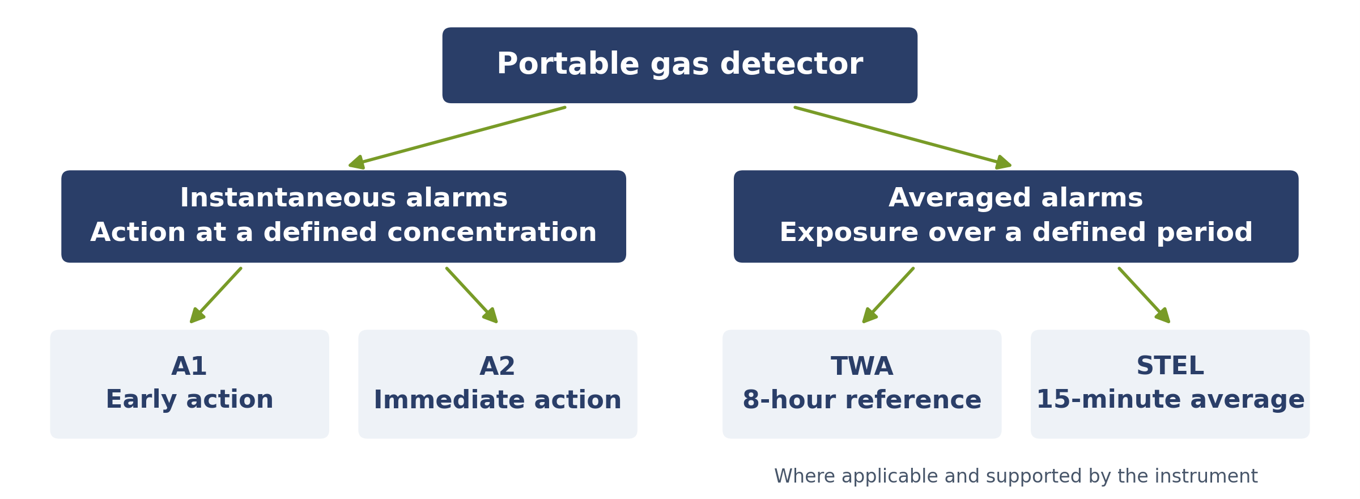
Figure 1. Instantaneous alarms prompt action at a defined concentration. Averaged alarms track exposure over the relevant period. Each function needs a defined response.
A1 and A2 prompt action when the measured concentration reaches a defined trigger. A1 might require the worker to pause a task and report a change in conditions. A2 might require immediate withdrawal under the site procedure.
The averaged alarm functions prompt intervention when exposure over the relevant period approaches or reaches the configured trigger. Workers need to understand the action required when these alarms activate.
What a reading above 20 ppm tells you
Consider a worker exposed to 8 ppm CO for seven and a half hours and 40 ppm for a total of 30 minutes across several tasks. This results in an 8-hour TWA of 10 ppm, half the new limit. An A1 alarm set at 20 ppm could still trigger several times as the concentration rises and falls.
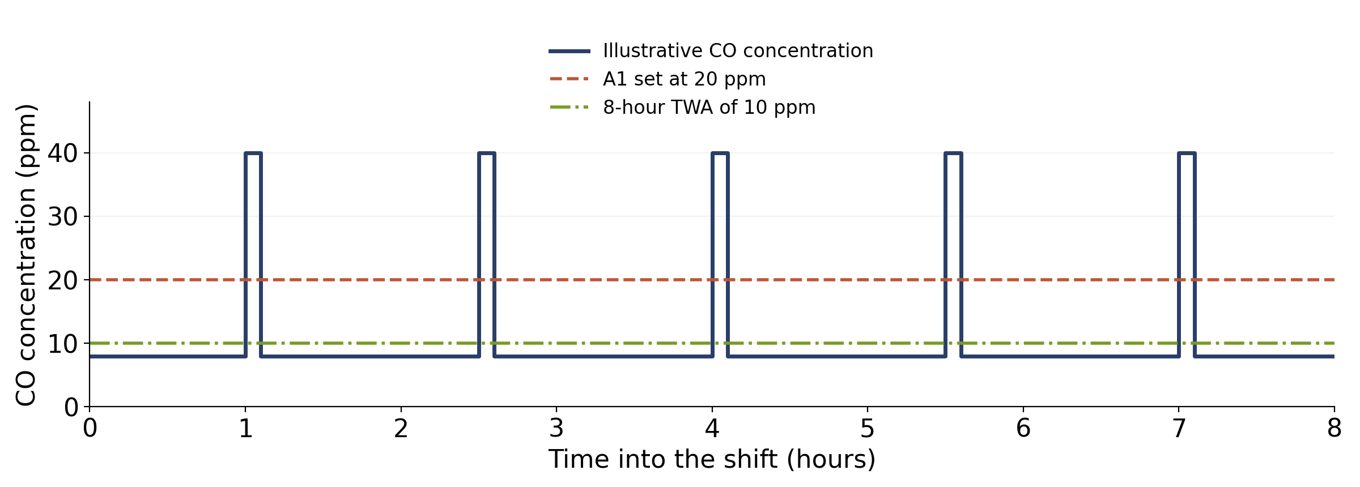
Figure 2. An illustrative shift with five six-minute rises to 40 ppm and 7.5 hours at 8 ppm. The 8-hour TWA is 10 ppm. The dashed line shows the 20 ppm A1 setting being discussed.
Those events are worth investigating. They can help pinpoint a source, identify a task associated with higher readings or show when ventilation needs attention. Determining whether the worker exceeded the 8-hour limit requires suitable exposure data over the relevant period.
Confusing an instantaneous alarm with a TWA exceedance creates three practical problems.
Alarm fatigue. When A1 sounds repeatedly and the usual response is to acknowledge it and carry on, workers can become desensitised to the alarm. Over time, that can undermine confidence in A2 as well.
Misreading the alarm log. An entry that says “CO alarm at 20 ppm” can easily be recorded as an exposure limit exceedance. The event log establishes that the instrument reached its programmed trigger. The exposure assessment establishes whether the applicable limit was exceeded.
An unclear response. A brief rise to 20 ppm and a concentration that stays near 20 ppm for hours call for different decisions. An instantaneous setpoint alone gives the worker little information about how long the concentration has been elevated or how much exposure has accumulated.
How sustained exposure below A1 is detected
An instantaneous alarm responds only to the concentration at that moment and does not show how much exposure has built up over the shift. A concentration that stays below the A1 setpoint can therefore go unflagged by A1, even though the averaged exposure keeps rising. Placing A1 above the TWA limit shows why the averaged alarm exists. Consider a detector with A1 set at 50 ppm. A worker exposed to a steady 45 ppm for eight hours could finish the shift without an A1 alarm.
Their TWA would be 45 ppm, or 2.25 times the new limit.
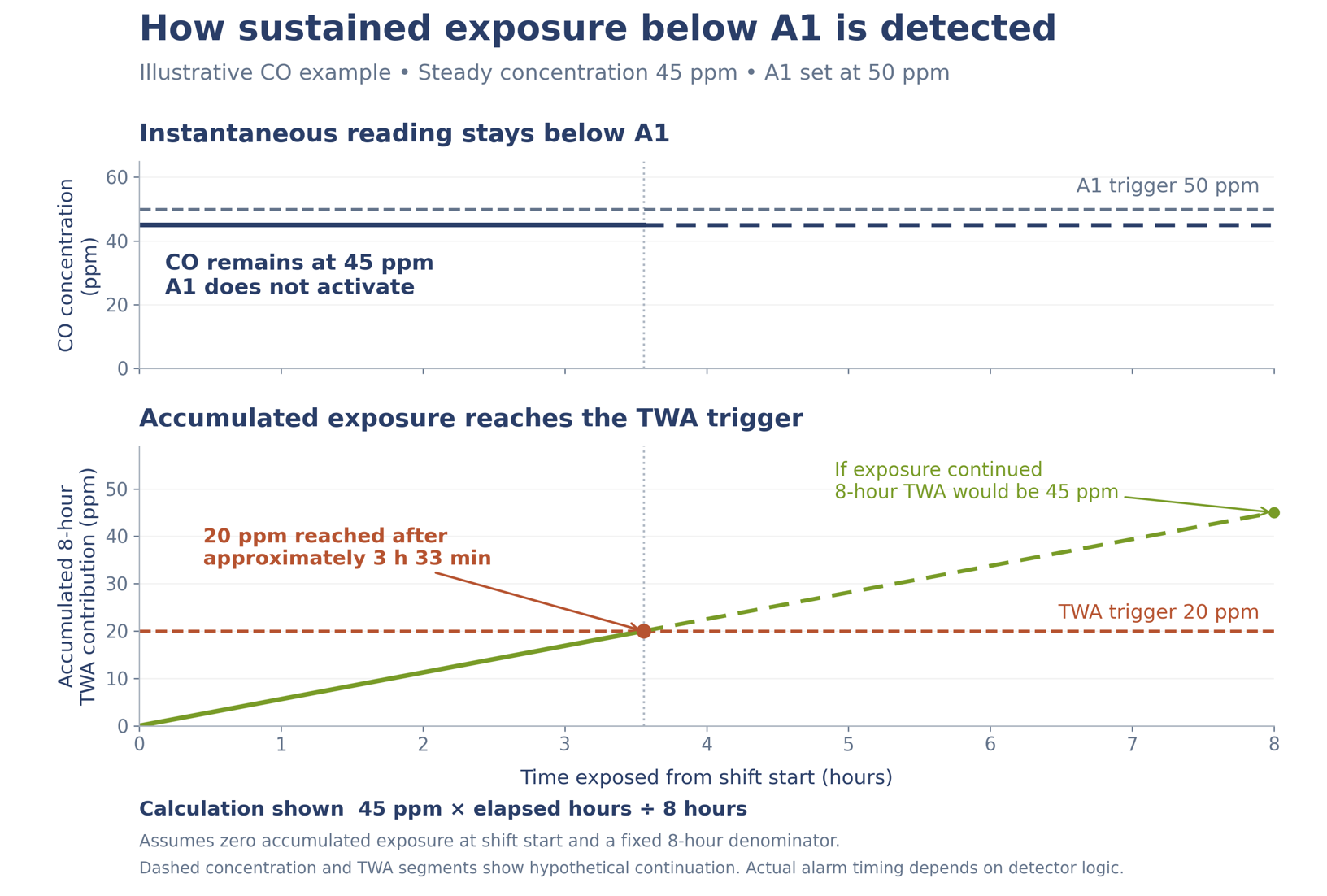
Figure 3. Sustained CO exposure below A1 can still reach the TWA trigger. This example assumes zero starting exposure and a fixed 8-hour denominator. Actual alarm timing depends on detector logic and configuration.
The 20 ppm 8-hour TWA is the reference for the CO exposure alarm. That function needs to be enabled, correctly configured and understood. A TWA pre-alert, where available, can provide an earlier opportunity to intervene. Any adjustment required for extended shifts also needs consideration. [1, 2]
For this strategy to work, workers and supervisors must understand what each instantaneous and averaged alarm means and know exactly what action to take when it is triggered. Source control, ventilation and appropriate work practices are needed to reduce the exposure itself.
Match the alarm strategy to the hazard
With those functions established, the next step is to consider how the gas causes harm and how quickly conditions can deteriorate. Where brief, high concentrations can cause rapid effects, instantaneous warnings need to allow enough time for workers to respond.
For CO, tracking exposure over time is essential, alongside instantaneous alarms that warn of sudden releases or high concentrations. The new Australian WEL list assigns CO a 20 ppm 8-hour TWA, with no separate STEL or peak limit. High short-term CO concentrations can still present an acute hazard, especially in poorly ventilated spaces. [1, 3]
Selecting A1 and A2 for the CO example
Safe Work Australia’s technical guide provides context for assessing short-term excursions. It describes a process as inadequately controlled if short-term exposures exceed three times the TWA limit for more than 30 minutes in total over eight hours, or if a single short-term value exceeds five times the TWA limit. For CO, those multiples correspond to 60 ppm and 100 ppm respectively. [1, 2]
These benchmarks help identify conditions that need attention. The setpoint decision must also account for the instrument’s response and the time needed for the worker to act.
A1 at 35–50 ppm is an illustrative early-action range. It places the trigger below the 60 ppm excursion benchmark and gives a defined opportunity to pause work, move clear as directed and investigate the source or controls. The range is a proposal for site assessment. It needs justification using the tasks, monitoring data, rate of concentration rise and required response.
A2 at 100 ppm is an illustrative immediate-action trigger. It aligns numerically with five times the 20 ppm TWA. A lower trigger may be needed to allow sufficient warning before that concentration is reached. A setting at 100 ppm requires particular attention to sensor delay, how quickly CO can build up, and the time needed to reach a safe location.
The suggested figures require assessment against site conditions. The excursion guidance does not establish a universally safe A1 or A2 setting, and the need for action can arise below either programmed trigger. Site logs can help identify recurring causes. Frequent alarms should prompt investigation of the source and controls before a setpoint is raised.
Applying the approach to STELs and peak limits
For a gas with a STEL, the same need to distinguish instantaneous readings from averaged exposure applies over 15 minutes. An instantaneous A2 alarm can provide an earlier warning, while the STEL function tracks the 15-minute average. Choose the immediate-action trigger to account for the acute hazard and the time workers need to respond.
A peak limit requires attention to very brief exposures. Where one applies, a fast-response alarm can help workers act before the peak limit is reached. Sensor response, measurement uncertainty and withdrawal time all affect the margin needed. [2]
Confirm the instrument can support the chosen settings
Before adopting the settings, confirm that the detector can reliably measure at the relevant concentrations and provide timely warning. Display resolution describes the smallest increment the screen can show. Detection and quantification limits, uncertainty, cross-sensitivity, drift and response time also affect the usefulness of the reading.
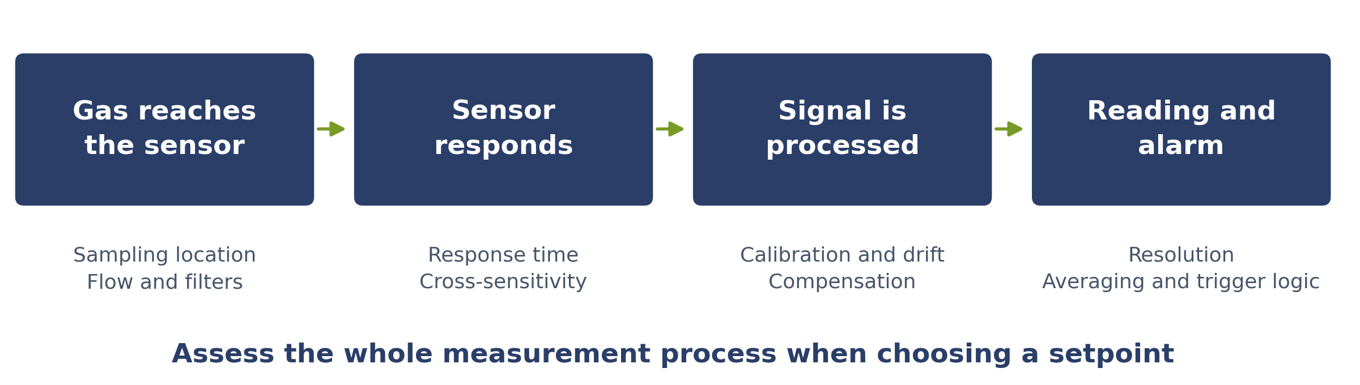
Figure 4. Sampling, sensing, signal processing and alarm logic all affect the result used to make a decision.
Check how the instrument calculates TWA and STEL, handles interruptions and resets its exposure history. Confirm that the monitoring method and the period covered are suitable for the intended assessment. [2]
Make the response and the record clear
Use A1 and A2 in the response plan and pair each with a clear instruction. Keep TWA and STEL for the functions that calculate those averages. Training should explain what each alarm means, what action it requires and who needs to be informed.
In the event record, capture the reading, the task, the conditions and the action taken. Record any exposure exceedance separately, once suitable monitoring data have been assessed against the applicable limit.
An alarm is an event. An exceedance is a finding.
The December changes are an opportunity to review the complete alarm strategy. Establish the action required, use the appropriate instantaneous or averaged function, and verify that the instrument can provide a reliable warning in time. Each selected setpoint should have a documented purpose, a justified basis and a response that workers understand.
That distinction also needs to be understood by the people relying on the detector. In workplaces where setting A1 alarms at the TWA has become established practice, a higher instantaneous setpoint may be interpreted as permitting greater exposure or weakening worker protection. Explaining the technical reasoning alone may be insufficient to overcome that concern.
Consultation and practical education are essential before revised settings are introduced. Workers, health and safety representatives, and relevant employee organisations should understand the purpose of each alarm, how averaged exposure is tracked and what action each trigger requires. The worked examples in this article can help explain the approach. Workers also need opportunities to question the proposed changes and practise the responses, so confidence in the alarm strategy develops alongside understanding.
References
[1] Safe Work Australia. Workplace exposure limits for airborne contaminants. November 2026. Carbon monoxide entry. Source
[2] Safe Work Australia. Air monitoring and the workplace exposure limits for airborne contaminants. Technical Guide. July 2026. Sections 3.1–3.3, 5.5.3 and Appendix E. Source
[3] SafeWork NSW. Carbon monoxide exposure. Safety alert. 29 October 2026. Source
 Ask Quick Question